
In an era of algorithmic trading and instant information, the disciplined investor's greatest advantage may be the simplest one: the willingness to think in decades rather than quarters.
The Compression of Time Horizons
Markets have always rewarded patience, but the modern financial landscape makes patience harder to practice. Real-time portfolio tracking, twenty-four-hour news cycles, and social media amplification compress our sense of time. A single trading day can feel consequential when it rarely is.
This compression creates a persistent temptation to act—to rebalance after every downturn, to chase whatever sector dominated last quarter, to mistake volatility for risk. But the historical record is unambiguous: the longer an investor's holding period, the more predictable and favorable the outcomes.
Process Over Prediction
No one reliably predicts short-term market movements. Not consistently. Not across multiple cycles. The track record of market timing, even among professionals managing billions of dollars, is poor enough to be statistically indistinguishable from chance.
What does work—reliably, across decades—is disciplined process:
- Asset allocation that reflects your actual time horizon, not your emotional state
- Rebalancing on a schedule, not in response to headlines
- Tax-loss harvesting as a systematic practice, not an afterthought
- Diversification that accounts for correlations during stress, not just during calm
These are not exciting strategies. They do not make for compelling dinner conversation. But they compound, quietly and relentlessly, in a way that reactive decision-making never does.
The Behavioral Premium
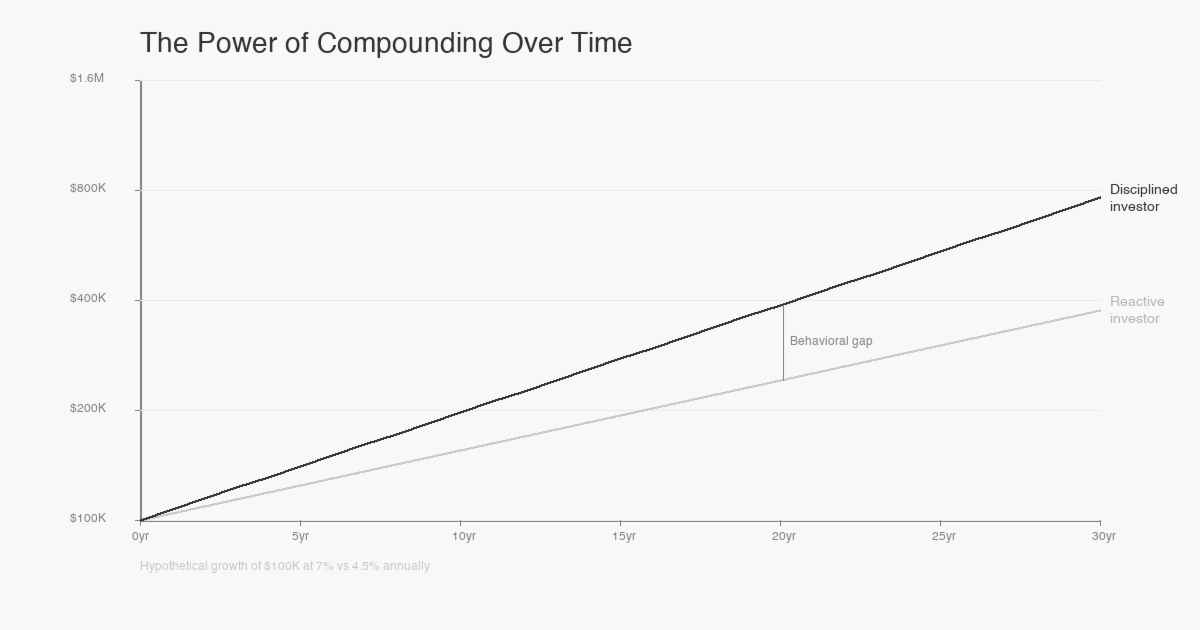
There is a measurable premium in simply staying the course. Dalbar's research has consistently shown that the average equity fund investor underperforms the funds they own by two to three percentage points annually—not because they choose poor funds, but because they buy high and sell low, driven by fear and greed operating on compressed time horizons.
The investor's chief problem—and even his worst enemy—is likely to be himself.
This behavioral gap is not a bug in human psychology that sophisticated investors have overcome. It is a persistent feature of markets that creates opportunity for those with the temperament and structure to resist it.
Building for Longevity
At its core, patient portfolio construction is about alignment. Aligning your investment approach with the actual timeline over which you will need the money. For most individuals building or preserving meaningful wealth, that timeline is measured in decades.
A twenty-year-old saving for retirement has a fifty-year horizon. A sixty-year-old entering retirement may need assets to last thirty years or more. Even a foundation or family trust may need to sustain itself across generations.
Against these time horizons, a difficult quarter—or even a difficult year—is a rounding error. The compounding engine of a well-constructed portfolio requires time as its primary input. Interrupting that process, even with good intentions, carries a measurable cost.
The Quiet Advantage
Patience in investing is not passive. It requires ongoing attention to the things that actually matter: tax efficiency, fee minimization, estate coordination, and alignment between investment strategy and life circumstances. It demands the discipline to ignore the things that do not matter, which, in practice, is most of what dominates financial media.
The quiet advantage of patient capital is that it compounds not just financially, but structurally. Fewer transactions mean lower costs. Longer holding periods mean more favorable tax treatment. Stable allocations mean less behavioral drag.
Outcomes depend less on prediction than on preparation, discipline, and behavior across cycles. That has always been true. It remains true now.